TLB Code Generation
Main concept
The DRRA fabric accesses application data using virtual addresses, while a communication buffer stores that data in a compact physical address space. The TLB Code Generation step produces the program that performs this virtual→physical translation for the TLBs attached to the communication memories on the DRRA side of each buffer.
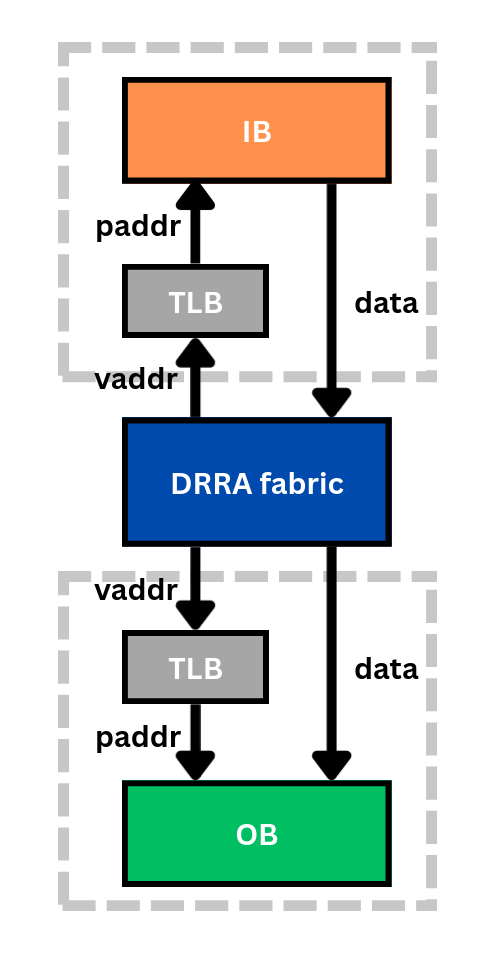 The TLB translates the DRRA's virtual addresses (vaddr) into the buffer's physical addresses (paddr).
TLB code is generated for every memory implementation except FIFO: a FIFO delivers data in order, so no address translation is needed. This is one reason FIFO buffers are preferred when the access pattern allows them.
Using the virtual and physical address mappings determined during Memory Synthesis, this step chooses an appropriate TLB implementation and generates its program. Two implementations are supported.
Conventional TLB
The conventional TLB stores an explicit virtual→physical map in a lookup table. It supports arbitrary addressing patterns at the cost of one table entry per address, so it can require a relatively large memory.
The table size is found by starting small and doubling until every mapping fits
without conflicts. The algorithm fills the table (indexing by virtual % size),
verifies that every virtual address reads back its expected physical address, and
— if any conflict is found — doubles the size and retries.
let mut tlb_size = 1;
loop {
    let mut tlb = vec![0; tlb_size];
    let mut fail = false;

    // place every mapping
    for i in 0..total_length {
        let v = virtual_addr[i];
        let p = physical_addr[i];
        tlb[v % tlb_size] = p;
    }

    // verify there were no conflicts
    for i in 0..total_length {
        let v = virtual_addr[i];
        if tlb[v % tlb_size] != physical_addr[i] {
            fail = true;
            break;
        }
    }

    if !fail { break; }
    tlb_size *= 2;
}
Address Generation Unit (AGU)
The AGU implementation does not store individual mappings; instead it computes the physical address directly with the affine, three-level nested-loop function
If Sylva can find values of A_{\text{base}}, the loop indices/bounds and the strides S_i, S_j, S_k that reproduce the required physical-address sequence, it programs those parameters into the AGU. The synthesis flow derives these values heuristically from the physical address pattern and then validates the generated function against the required sequence.
Because the AGU needs far less hardware than a full lookup table, it is preferred whenever the pattern can be expressed with affine indexing and strides. The conventional TLB is used as the fallback for irregular patterns.
Relationship to the hardware
The generated programs are loaded at run time by the AlImp firmware into the
tlb
components (translate_buf for the conventional TLB, translate_agu for the AGU)
through the peripheral interface. See the
Hardware Architecture page for the surrounding hardware.